Why That Influencer's Outfit Hits Different on Your Screen Than It Does in Your Mirror
The Post Looked Perfect. The Outfit Did Not.
You screenshot it. You saved it to your inspo board. You tracked down every single piece, ordered two sizes just in case, and stood in front of your bathroom mirror ready for the transformation. And then... nothing. The silhouette felt off. The proportions were weird. The whole thing just sat on your body like it was waiting to go back in the box.
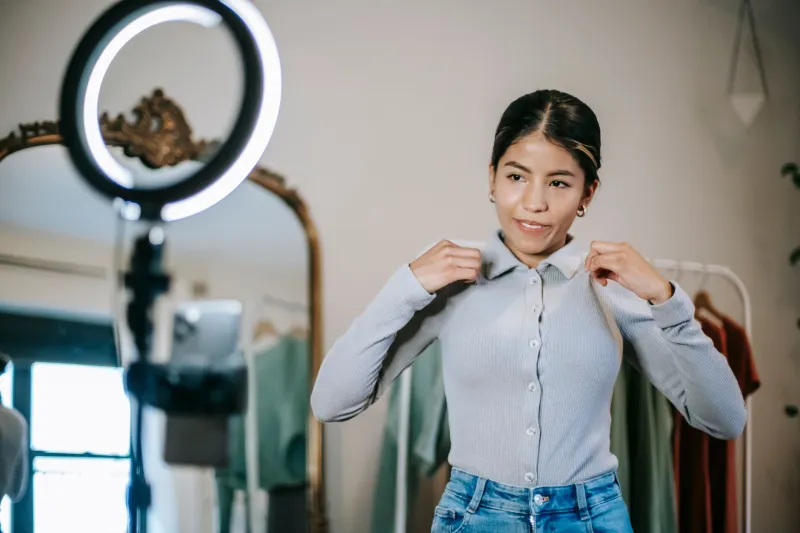
Sound familiar? You're not imagining it, and there's nothing wrong with you. What you're experiencing is the very predictable result of chasing a look that was engineered — often by a team of professionals — to exist perfectly in a single, controlled moment. Real life just doesn't come with a ring light.
The Production Behind the Post
Here's the part nobody talks about when they're sharing a "casual GRWM" reel: what looks effortless online is almost never actually effortless. Many full-time influencers work with stylists who pull and prep looks, photographers who understand how to use natural light, and editors who color-grade images until the fabric reads exactly the way they want it to.
Even the creators who shoot on their iPhones know their angles. They've spent months — sometimes years — figuring out exactly which lighting in their apartment makes their skin glow, which corner of the room compresses the background in a flattering way, and which poses minimize or emphasize whatever they want you to see. That's not deception. That's just craft. But when you buy the outfit without the craft, you're only getting half the equation.
Lighting Is Doing More Work Than the Clothes Are
This one is genuinely underrated. Soft, diffused natural light — the kind you get from a big window on a cloudy day — smooths out texture, softens shadows, and makes even a basic cotton tee look editorial. Harsh overhead lighting (which is what most of us are working with in our homes, offices, and dressing rooms) does the exact opposite. It creates shadows in places you don't want them, makes fabrics look flat, and turns a beautiful drape into something that just looks... wrinkled.
The next time an outfit isn't reading the way you expected, try stepping outside or standing near a large window before you write it off. You might be surprised how much the clothes change when the light does.
Body Diversity and the Illusion of a Universal Look
Fashion content has gotten more inclusive in recent years, and that's genuinely great. But the algorithm still tends to surface certain body types more than others, and even when it doesn't, there's a deeper issue at play: clothes are cut to fit specific proportions, and those proportions don't match everyone.
When you see a wide-leg trouser look incredible on someone with a long torso and narrow hips, that's not just about the pant — it's about the specific way that pant interacts with that body. Put those same trousers on someone with a shorter rise or a different hip-to-waist ratio and the whole visual logic shifts. Neither body is wrong. The styling just needs to be recalibrated.
This is why copying a look piece-for-piece rarely works. The individual items aren't the formula — the relationship between the clothes and the body wearing them is.
Context Is a Styling Tool (And You Probably Don't Have Theirs)
A lot of influencer content is shot on location — a cobblestone street in a trendy neighborhood, a rooftop in a city you don't live in, a coffee shop with exposed brick and perfect afternoon light. The environment is doing serious styling work in those shots, and it's easy to forget that when you're focused on the outfit.
That same look, photographed in a suburban parking lot or a fluorescent-lit break room, is going to read completely differently. That doesn't mean it's a bad outfit. It means context is a variable that most of us can't replicate — and probably don't need to. The real question is whether the look works in your context, not theirs.
Stop Reverse-Engineering Their Wardrobe. Build Your Own Logic.
The most useful thing you can take away from influencer content isn't the specific pieces they're wearing — it's the underlying styling principles they're using. Ask yourself: What's the proportion play here? Is one element oversized while everything else is fitted? Is there a single statement piece anchored by basics? Is the color palette doing the heavy lifting while the silhouettes stay simple?
When you start watching content through that lens, you stop shopping for their exact outfit and start identifying the moves that translate across different bodies, budgets, and lifestyles. That's where personal style actually lives — not in the specific cargo pants they linked in their bio, but in the logic behind why those pants worked with what they wore them with.
A Framework That Works for Your Real Life
Here's a simple filter to run any inspo through before you add it to your cart:
Does the occasion match your actual life? If your day-to-day is casual and the look is clearly styled for a night out or a brand trip, it's not a reference point for your wardrobe — it's entertainment.
Are the proportions based on a body that shares your silhouette? If not, look for the principle (the balance of fitted versus relaxed, the hem length, the layering) rather than the exact pieces.
Can you recreate the styling environment? If the look only works in a specific context you'll never be in, that's worth factoring in.
Is the piece doing the work, or is the whole production? If you stripped away the location, the lighting, and the styling, would you still want that item?
You Were Never the Problem
Fashion content is aspirational by design. It's supposed to make you want things. And there's nothing wrong with enjoying it, drawing inspiration from it, or even buying pieces you discovered through it. The shift happens when you stop measuring yourself against a look that was never designed to exist outside a curated frame.
Your wardrobe doesn't need to be Instagram-ready. It needs to be you-ready — built around your proportions, your lifestyle, and the version of style that actually shows up in your real, unfiltered, no-ring-light daily life. That's not a consolation prize. That's the whole point.